Biases in decision making

Biases in decision making are one of the most dangerous pitfalls during an innovation process. Dangerous because organizations are not aware of the biases, feel overconfident and pursue routes that do not make a difference to the customer or even fail.

We researched the literature on cognitive biases in judgement and decision making and analyzed which biases mostly hinder innovation and growth success. They are:

  • Repetition Bias: We tend to believe things that are often repeated

  • Confirmation Bias: We tend to only use information that confirms our preexisting believes

  • Stereotyping: We tend to fill in characteristics from stereotypes, generalities and prior histories

  • Recency Bias: We tend to attribute more value to new information compared to older information

  • Sunk Cost Fallacy: We tend to hold on to things in which we have invested a lot of time or money.
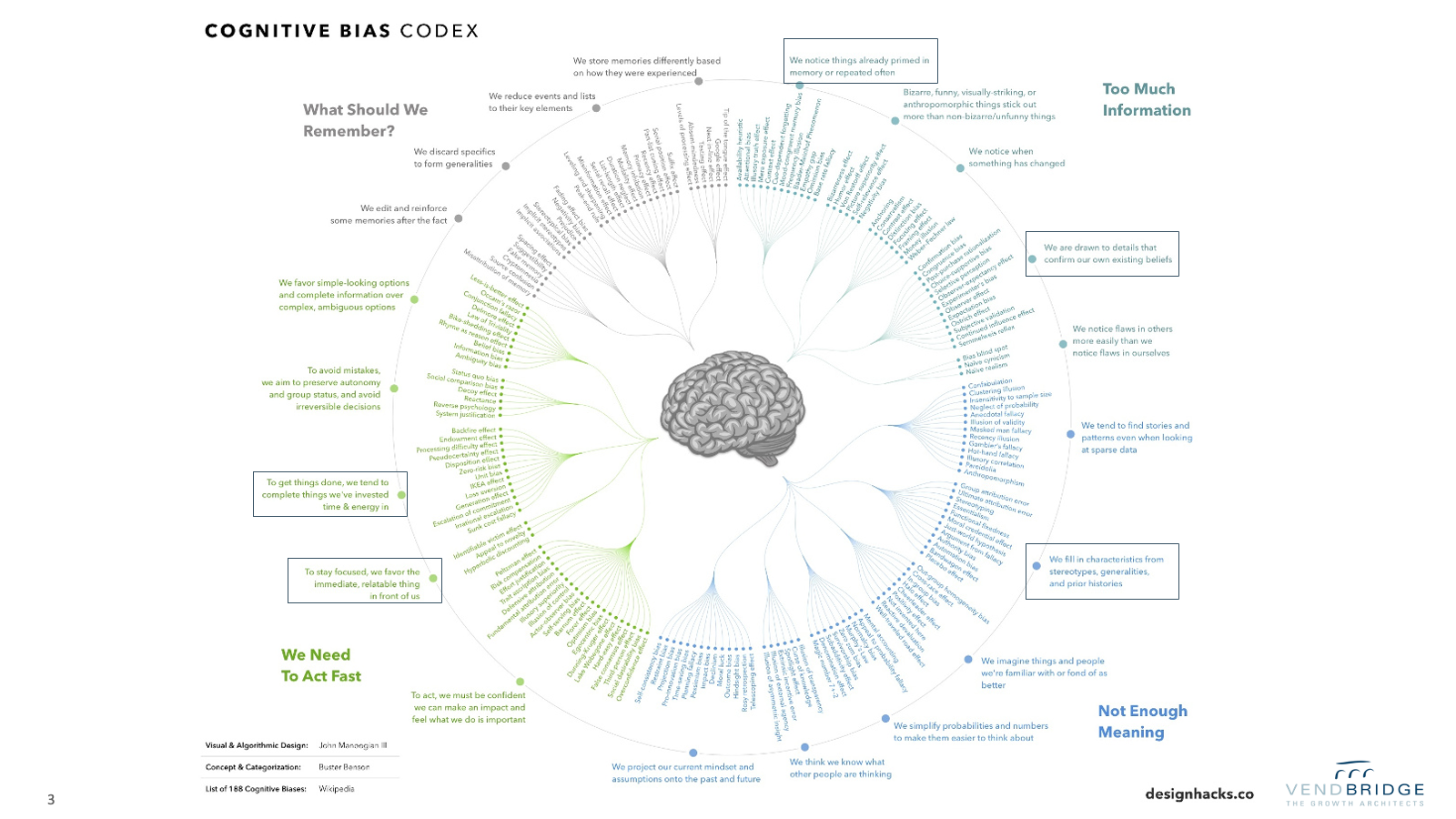
CFI is designed to overcome biases systematically and produce insight that is backed up by qualitative and quantitative data.
By framing the problem from the customers point of view and interviewing them about what they do, think and feel during their customer journey we gather qualitative insight that already prevent a large portion of potential stereotyping and recency bias. By quantifying those insights we can further reduce the confirmation and repetition bias.
Spinning the results into actionable ideas that target the actual customer problems avoids the sunk cost fallacy when developing new products or services.

In short; CFI de-biases your innovation decision making and challenges assumptions and believes in the organization with hard facts.

Become a Growth Architect: Measure needs with Jobs-to-be-done

Buy nowLearn more

Let's meet!

  • Hi, I'm Beat
  • Hi, I'm Yann

Jobs-to-be-done

  • Jobs-to-be-done is a way to think
  • What is a Job?
  • Job example: Public transport
  • Job example: Ed-tech
  • Job example: Car manufacturer
  • Lesson summary and outlook

Pitfalls in designing growth initiatives

  • Technology-first approach
  • Ocean of ideas
  • Biases in decision making

The CFI process

  • CFI in a nutshell
  • Frame
  • Discover
  • Spin
  • Action
  • Summary

Framing

  • Case study
  • The purpose of Frame
  • Business intention
  • Get inspired: Other business intentions
  • Target group in B2C
  • Target group in B2B
  • Brainstorm a Jobs-to-be-done hypothesis
  • The Jobs-to-be-done Hierarchy
  • Finding the right Focus Job
  • Get inspired: Framing examples
  • Jobs-to-be-done Hierarchy template
  • Lesson summary and outlook

Qualitative Discovery

  • Purpose of qualitative interviews
  • Get ready!
  • JTBD interview excerpt
  • Start the Jobs-to-be-done interview
  • Validating the JTBD hierarchy
  • Structure of a Job Metric
  • Get Job Metrics from participants
  • Try to find Job Metrics
  • Job Metrics we heard
  • More Job Metric extraction techniques
  • Why do Job Metrics have to be precise?
  • Consolidate Job Metrics into one long list
  • Interview plan and guide
  • I can't quantify: What can I do?
  • Value Map template and workshop instructions
  • Lesson summary and outlook
  • FAQs on qualitative interviews

Quantitative Discovery

  • Purpose of quantifying Jobs-to-be-done
  • Select Job Metrics for quantification
  • Structure of a CFI survey
  • Run a Jobs-to-done survey
  • Analyzing Jobs-to-be-done data
  • The Value Map
  • The Journey Navigator
  • Datafile Template to analyze and visualize the data
  • Drawing conclusions from data
  • Lesson summary and outlook

Spin

  • Purpose of Spin
  • Vendbridge Value Proposition canvas
  • Value Proposition workshop
  • Pain Matching
  • Pain Matching tool template
  • Lesson summary and outlook

Action

  • Keep the customer at the table!
  • New idea? Only when it solves a Pain Point
  • More cases and Info

Q&A

  • Q&A Session

Glossar

  • List of terms and definitions